Showing posts with label Algorithms. Show all posts

Thursday, December 9, 2010

Human Creativity in hardwares

You can't imagine how much I was excited when I saw this in ACM tech news. The title of this, is:

New Psychology Theory Enables Computers To Mimic Human Creativity at Rensselaer Polytechnic Institute


Could you imagine a computer which is able to answer questions need creativity?
like this question:

A dealer in antique coins gets an offer to buy a beautiful bronze coin. The coin has an emperor’s head on one side and the date “544 B.C.” stamped on the other. The dealer examines the coin, but instead of buying it, he calls the police. Why?

Ron Sun and Sèbastien Hèlie in their recent paper (appeared in the July edition of Psychological Review) introduced “Explicit-Implicit Interaction Theory,”
Sun has developed CLARION computer program(like a cognitive system) based on this theory.
Comparing the performance of the CLARION model with results from previous human trials – including tests involving the coin question was amazing:
Clarion, answered these kinds of questions with a great accuracy correctly in several aspects of problem solving.
The researchers say the theory, which explains how humans solve problems creatively, could provide a blueprint to building AI systems that perform tasks like humans.

If you remember, one of my recent posts was about moral judgment: "killing one to save five". ClARION is a very useful software for simulating these kind of tasks, I can't wait to see the results. I am eager to know how much CLARION's moral judgment is like ours.

You can see the RPI news about this, here.

Saturday, October 16, 2010

Interent is a brain? Is it intelligent?

About 10 years ago I heard an idea from professor Caro Lucas. I think it's good to tell you about this unique idea:
When we have a lot of connections in a system, This system will be intelligent, such thing is happened in our brain."We don't know why, but the result of these connections is intelligence."Lucas said.(It's a long time and maybe I forget some part of this idea)

I was thinking if this idea be true, something strange is happenning:
Nowadays we have systems with a lot of connections like internet: netwoks of networks; so Internet is intelligent? If yes how can this newborn baby show it's intelligence to us. how much it's IQ is? Can it help us? (Ouch! My mind said.)

I search the web to know more about these ideas: I found this site, Jeff Stibel has written an article which is started with these sentences :
The Internet is a brain. There, I said it. It has taken me far too long to publicly utter those words. And not because I don't believe them, but for fear that people will think I am crazy.

I like to work on this topic for my bachelor theses, differece and similarity between brain and internet but when I asked about this, Many stare at me in a strange way and implied: What do you say? Are you crazy!

I will be thankful if you tell me about your ideas

some useful links about this idea:
BBC News : Brain works more like internet than 'top down' company
Wikipedia: about Wiered for thought book

Saturday, October 9, 2010

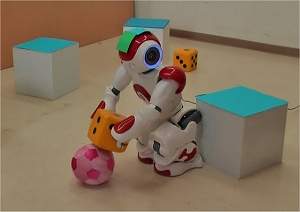
Nao, a good boy who learns by experiment

Nao is a robot who learns by experiment. In his website, there are four videos of his curiousness. In the first video, after a nice nap he wakes up to find himself in a new place. He takes a walk and he himself explains what he is doing in his robot like voice, then he learns many things like: it is impossible to put a cube on a ball or some boxes are movable and some are not.
He predicts what will happen and if his prediction is wrong he tries to find out why.

Monday, September 20, 2010

My blog in persian


My blog in Persian, it's mostly about Brain and anything related :
Hope you like it.
^_^


Saturday, July 31, 2010

TEDLikia

Today I got TEDLikia :) I have watched 4 videos up to now.

The first one was about robots and their emotions, David Hanson the lecturer brought Einstein face robot to the scene. It was fun, Einstein smile and frown to David. At first I thought David is working on brain-like algorithms but he didn't mention anything so I thought he might not use them.


second video was about Prakash institute in India. I like it very much. Parkash is trying to cure blindness of some children and then during their recovery study children's brains to realize how brain learn to see. At first, cured children were able to determine a square and a circle separately but if they saw a circle covered with part of a square they couldn't recognize neither square nor circle. amazingly after recovery children's brains could see things correctly.
their study about how brain learn to see is published in Nature magazine.


The third video was interesting, it was about hallucination. It happens to 10% of people who have visual or hearing loss. The type of hallucination is called Charles Bonnet syndrom. People with this syndrome hallucinate shapes, objects, faces etc... around them. FMRI studies show their Fusiform Gyrus in the temporal lobe becomes active so they see such things. A person of note who has this syndrome is lecturer Oliver Sacks.


Forth one was about brain computer interface. The lecturer showed the ability of her program and headset. A boy came to the stage and his brainwaves(thoughts) move an object in computer.

Wednesday, July 28, 2010

joking computer

************
what do you call a spicy society ?
a hot club .
************
Is it a good joke? I think your judgment about this joke will be changed if you know about a computer which has made this joke.
Yes, A computer.
this computer program is available online here.
I couldn't understand some jokes of this program, I don't know it's because of my poor English knowledge or the jokes were not jokes :)
I checked joke making algorithms I only have found 3 or 4 simple rules.
This program that is called joking computer is designed to help children who suffer some brain diseases and they are not able to communicate with other people easily.
I hope it becomes helpful for them.