Showing posts with label brain simulation. Show all posts

Friday, February 11, 2011

Dual ... A keyword for modeling the brain

Dual representation
Dual working
Dual neurons
Dual ....
These days it seems Brain modelers are more interested in using dual things in their models and interestingly by using this word, they have got good results.
Here are some examples of some works around the world:
  • USA: Professor Ron Sun's cognitive architecture, He's used dual representation of the brain to build a cognitive modeling software, CLARION. He was so successful in creating creativity in hardware(one of my two last posts was about this.)
  • Iran: Professor Majid Nili AhmadAbadi: Recently, In AmirKabir cognitive science seminars he talked about good results comes by combining two models and used a dual... I searched the article he talked about but I didn't find it. This article seems to be another successful dual model he works on.
I've searched the net to find a theory about what exactly this dual is, and I found Dual-Coding theory.
Maybe the parallel nature of processes in the brain and the relation between different parts of the brain makes this dual works well.
Maybe triplex, foursome, quintuplet, .... works better, betterer,bettererer,... :)

Thursday, December 9, 2010

Human Creativity in hardwares

You can't imagine how much I was excited when I saw this in ACM tech news. The title of this, is:

New Psychology Theory Enables Computers To Mimic Human Creativity at Rensselaer Polytechnic Institute


Could you imagine a computer which is able to answer questions need creativity?
like this question:

A dealer in antique coins gets an offer to buy a beautiful bronze coin. The coin has an emperor’s head on one side and the date “544 B.C.” stamped on the other. The dealer examines the coin, but instead of buying it, he calls the police. Why?

Ron Sun and Sèbastien Hèlie in their recent paper (appeared in the July edition of Psychological Review) introduced “Explicit-Implicit Interaction Theory,”
Sun has developed CLARION computer program(like a cognitive system) based on this theory.
Comparing the performance of the CLARION model with results from previous human trials – including tests involving the coin question was amazing:
Clarion, answered these kinds of questions with a great accuracy correctly in several aspects of problem solving.
The researchers say the theory, which explains how humans solve problems creatively, could provide a blueprint to building AI systems that perform tasks like humans.

If you remember, one of my recent posts was about moral judgment: "killing one to save five". ClARION is a very useful software for simulating these kind of tasks, I can't wait to see the results. I am eager to know how much CLARION's moral judgment is like ours.

You can see the RPI news about this, here.

Thursday, November 18, 2010

killing 1 to save 5?

Would you kill 1 to save 5?
Assume there are 2 railroads, five workers are working on line 1 and one worker is working on line 2.
suddenly a train ()()()() appears on line 1, This train definitely will kill 5 workers on line 1. You are watching this in a control room, you can direct the train to line 2 by pushing a button.
pushing the button means killing the worker on line 2 and saving 5 workers on line 1.
What would you do?

line1 =()()()()======1=2=3=4=5====
....................\\................................
line2 ===============1========


Nowadays scientists are simulating the process of making these kind of decisions on computers.(actually different versions of this question)
It looks interesting. Doesn't it?
I will post more about these simulations later.

Saturday, October 16, 2010

Interent is a brain? Is it intelligent?

About 10 years ago I heard an idea from professor Caro Lucas. I think it's good to tell you about this unique idea:
When we have a lot of connections in a system, This system will be intelligent, such thing is happened in our brain."We don't know why, but the result of these connections is intelligence."Lucas said.(It's a long time and maybe I forget some part of this idea)

I was thinking if this idea be true, something strange is happenning:
Nowadays we have systems with a lot of connections like internet: netwoks of networks; so Internet is intelligent? If yes how can this newborn baby show it's intelligence to us. how much it's IQ is? Can it help us? (Ouch! My mind said.)

I search the web to know more about these ideas: I found this site, Jeff Stibel has written an article which is started with these sentences :
The Internet is a brain. There, I said it. It has taken me far too long to publicly utter those words. And not because I don't believe them, but for fear that people will think I am crazy.

I like to work on this topic for my bachelor theses, differece and similarity between brain and internet but when I asked about this, Many stare at me in a strange way and implied: What do you say? Are you crazy!

I will be thankful if you tell me about your ideas

some useful links about this idea:
BBC News : Brain works more like internet than 'top down' company
Wikipedia: about Wiered for thought book

Saturday, October 9, 2010

Nao, a good boy who learns by experiment

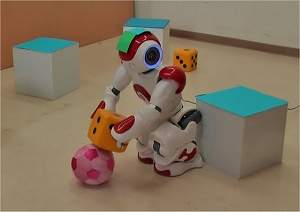
Nao is a robot who learns by experiment. In his website, there are four videos of his curiousness. In the first video, after a nice nap he wakes up to find himself in a new place. He takes a walk and he himself explains what he is doing in his robot like voice, then he learns many things like: it is impossible to put a cube on a ball or some boxes are movable and some are not.
He predicts what will happen and if his prediction is wrong he tries to find out why.

Saturday, October 2, 2010

a weblog about brain

Hi everybody
A new born weblog that is about brain is now ready to be studied :)
This is My friend, Sepideh's blog.
you can see it here. ^_^

Wednesday, September 29, 2010

Researcher Builds Machines That Daydream

An effort to develop algorithms that would enable computers to think freely and convey emotions was discussed recently at the World Computer Congress in Brisbane, Australia. Murdoch University professor Graham Mann says intelligent systems should have emotions built into them before they can function.
"I believe that it is possible--if we start to model the way human beings reason about things--to achieve much more flexible processing of storylines, plans, even understanding how human beings behave," he says.
The machine freely associated three stories: The Thirsty Pigeon; The Cat and the Cock; and The Wolf and the Crane.
When queried on the association, the machine responded: "I felt sad for the bird.".

Monday, September 20, 2010

My blog in persian


My blog in Persian, it's mostly about Brain and anything related :
Hope you like it.
^_^


Wednesday, September 1, 2010

Brain knows how to use Diversity


Like snowflakes, no two neurons are exactly alike, But it’s not the size or shape that sets one neuron apart from another, it’s the way it responds to incoming stimuli. Carnegie Mellon university researchers discovered that diversity is vital to comprehensive brain function. Their research published in Nature Neuroscience.
Typically neuroscientists average to obtain their results, assuming that the variability is a “bug of biology"
“When we think about computer chips, variability in hardware clearly can be very destructive. Manufacturers spend a lot of time and expense making sure each processor on a chip is identical,” Urban said. “The brain is considered to be one of the most sophisticated computers there is. We were intrigued by the idea that the brain might make use of the messy, complex nature of its biological hardware to function more efficiently.”
Full Article

Saturday, July 31, 2010

TEDLikia

Today I got TEDLikia :) I have watched 4 videos up to now.

The first one was about robots and their emotions, David Hanson the lecturer brought Einstein face robot to the scene. It was fun, Einstein smile and frown to David. At first I thought David is working on brain-like algorithms but he didn't mention anything so I thought he might not use them.


second video was about Prakash institute in India. I like it very much. Parkash is trying to cure blindness of some children and then during their recovery study children's brains to realize how brain learn to see. At first, cured children were able to determine a square and a circle separately but if they saw a circle covered with part of a square they couldn't recognize neither square nor circle. amazingly after recovery children's brains could see things correctly.
their study about how brain learn to see is published in Nature magazine.


The third video was interesting, it was about hallucination. It happens to 10% of people who have visual or hearing loss. The type of hallucination is called Charles Bonnet syndrom. People with this syndrome hallucinate shapes, objects, faces etc... around them. FMRI studies show their Fusiform Gyrus in the temporal lobe becomes active so they see such things. A person of note who has this syndrome is lecturer Oliver Sacks.


Forth one was about brain computer interface. The lecturer showed the ability of her program and headset. A boy came to the stage and his brainwaves(thoughts) move an object in computer.

Wednesday, July 28, 2010

Thursday, July 8, 2010

Caro Lucas


Yesterday I was preparing a text about Randy Pausch for the blog ;A great computer scientist who passed away two years ago because of cancer, unfortunately today I heard something that I should add to this post, death of professor Caro Lucas; Iranian robotic father ,A person I love, here you can see enormous number of his articles. I think he died of cancer too.
I always wish to be his student :(
Although we(world) have lost one of the most valuable people, I am sure way of his thinking will stay alive for ever.
Scientists! please, please find a way to cure cancer, It is killing somebody we love.

Wednesday, June 30, 2010

How a Computer Program Became Classical Music's Hot, New Composer


University of California, Santa Cruz professor David Cope has developed Emily Howell, a music-composing program that generates its own compositions by following musical rules that Cope has taught it. The program is only fed music composed by an earlier program of Cope's, Experiments in Musical Intelligence. Critics say that Emily's music, while impressive, lacks the ability to trigger emotional reactions in listeners. A 2008 University of Essex study determined that the human brain has a stronger emotional reaction to music played by humans than by machines, even when the listener does not know the source of a performance. Cope says that Emily and other programs capable of artistic creation offer an opportunity for collaboration with human artists, rather than replacing them. "Computers are there [for us] to extend ourselves through them," he says. "It seems so utterly natural to me. It's not like I taught a rock to compose music."
full article

Friday, June 25, 2010

We have limitations?

Hello guys
last week I saw an article with this title "Limitations of human brain mean we may never understand the secrets of universe, says Britain's top scientist", I was surprised how this can be possible, we have limitations but our equipments do not have limitations and also we are able to add extra memory, processor's and so on to our brains who said we can't.
I hope this guy with this nice smile have answers for these issues.

Do you agree with me?

Tuesday, June 22, 2010

Researchers predict human visual attention using computer intelligence for the first time


Queen Mary, University of London scientists have developed a computer-based model to better understand change blindness--the inability for people to see obvious changes to scenes around them. "The biologically inspired mathematics we have developed and tested can have future uses in letting computer vision systems such as robots detect interesting elements in their visual environment," says Queen Mary professor Peter McOwan. As part of the study, participants were asked to spot the differences between pre-change and post-change versions of a series of pictures. To eliminate bias, the researchers developed an algorithm that enabled the computer determine how to change the images that study participants were asked to view. In addition to being able to predict change blindness, the research showed that the addition or subtraction of an object from the scene is detected more often than changes in the color of the object. The researchers say the model will be useful in designing displays for road signs, emergency services, security, and surveillance to draw attention to a change or part of the display that requires immediate attention.
Full article

Tuesday, December 8, 2009

Cat Fight Brews Over Cat Brain


The Story begins when Modha announced that his team has completed simulation of a cat brain. At this time Henry Markram a leading neuroscientist who is trying to make a detailed simulation model of the human brain took umbrage at their work and he wrote the following letter. He called their work a hoax.


Dear Bernie,

You told me you would string this guy up by the toes the last time Mohda made his stupid statement about simulating the mouse's brain.

I thought that having gone through Blue Brain so carefully, journalists would be able to recognize that what IBM reported is a scam - no where near a cat-scale brain simulation, but somehow they are totally deceived by these incredible statements.

I am absolutely shocked at this announcement. Not because it is any kind of technical feat, but because of the mass deception of the public.

1. These are point neurons (missing 99.999% of the brain; no branches; no detailed ion channels; the simplest possible equation you can imagine to simulate a neuron, totally trivial synapses; and using the STDP learning rule I discovered in this way is also is a joke).

2. All these kinds of simulations are trivial and have been around for decades - simply called artificial neural network (ANN) simulations. We even stooped to doing these kinds of simulations as bench mark tests 4 years ago with 10's of millions of such points before we bought the Blue Gene/L. If we (or anyone else) wanted to we could easily do this for a billion "points", but we would certainly not call it a cat-scale simulation. It is really no big deal to simulate a billion points interacting if you have a big enough computer. The only step here is that they have at their disposal a big computer. For a grown up "researcher" to get excited because one can simulate billions of points interacting is ludicrous.

3. It is not even an innovation in simulation technology. You don't need any special "C2 simulator", this is just a hoax and a PR stunt. Most neural network simulators for parallel machines can can do this today. Nest, pNeuron, SPIKE, CSIM, etc, etc. all of them can do this! We could do the same simulation immediately, this very second by just loading up some network of points on such a machine, but it would just be a complete waste of time - and again, I would consider it shameful and unethical to call it a cat simulation.

4. This is light years away from a cat brain, not even close to an ants brain in complexity. It is highly unethical of Mohda to mislead the public in making people believe they have actually simulated a cat's brain. Absolutely shocking.

5. There is no qualified neuroscientist on the planet that would agree that this is even close to a cat's brain. I see he did not stop making such stupid statements after they claimed they simulated a mouse's brain.

6. You should also ask Mohda where he got the notion of "reverse engineering" from, when he does not even know what it means - look the the models - this has nothing to do with reverse engineering. And mouse, rat, cat, primate, human - ask him where he took that from? Simply a PR stunt here to ride on Blue Brain.

That IBM and DARPA would support such deceptive announcements is even more shocking.

That the Bell prize would be awarded for such nonsense is beyond belief. I never realized that such trivial and unethical behavior would actually be rewarded. I would have expected an ethics committee to string this guy up by the toes.

I suppose it is up to me to let the "cat out of the bag" about this outright deception of the public.

Competition is great, but this is a disgrace and extremely harmful to the field. Obviously Mohda would like to claim he simulated the Human brain next - I really hope someone does some scientific and ethical checking up on this guy.

All the best,

Henry

the letter is from IEEE Spectrum